There are roads that become destinations, and there are roads that become mirrors.
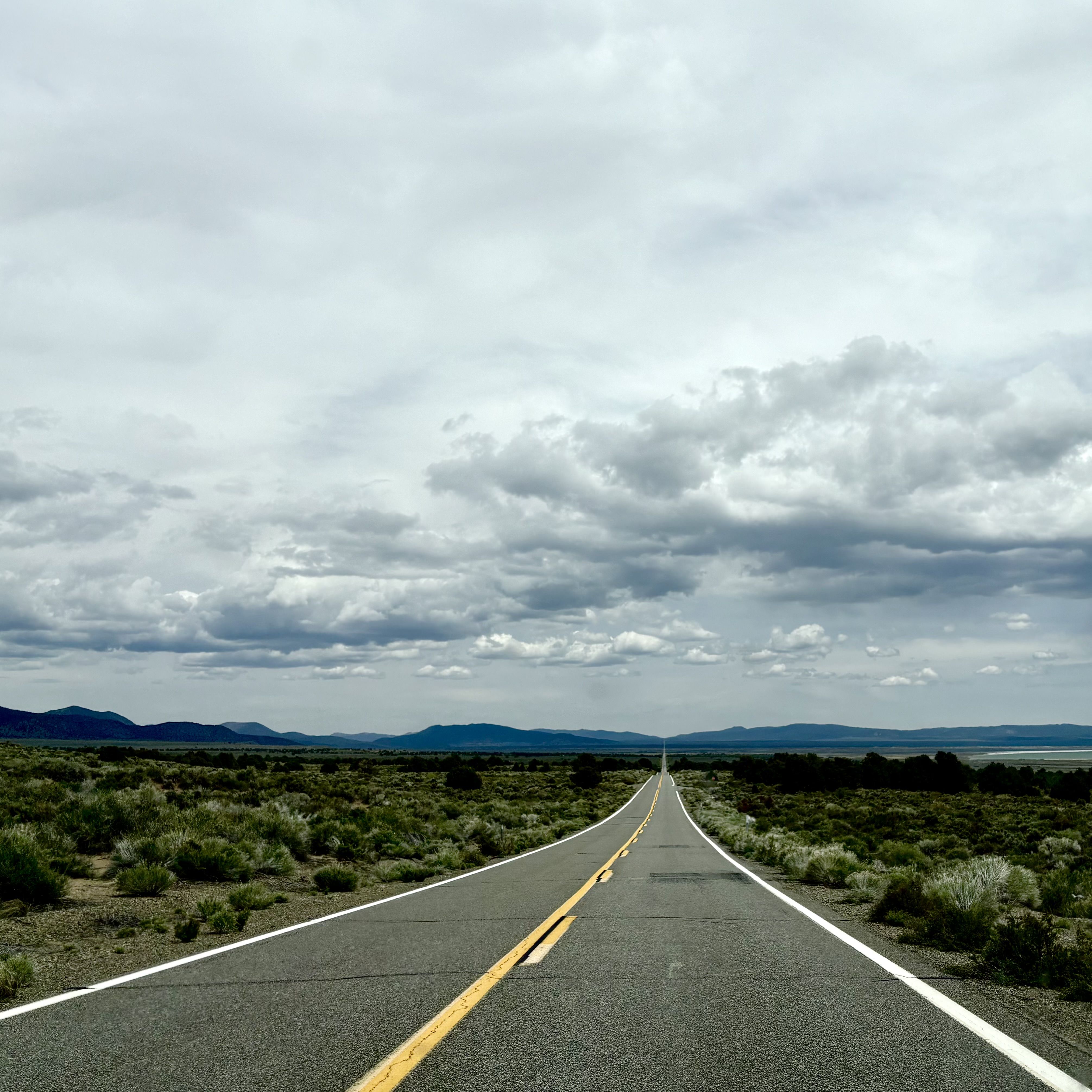
America’s Loneliest Road belonged to the second category. When people ask me about memorable drives, they usually expect stories of mountains and coastlines, dramatic weather and scenic views, places where nature performs generously and leaves little work for the observer. X5 and I have rarely chosen emptiness. We belong to mountain passes with switchbacks and cliffs where your hands stay alert and perspective feels earned. We belong to coastlines bending around seastacks and roads tracing rivers and valleys. We stop for waterfalls and lakes because water has always felt emotionally important to me in ways I have never fully explained or experienced. We slow for horses in California, cows in Montana, elk in Wyoming, moose standing impossibly still at dusk, bison becoming silhouettes at sunset. Looking back now, I realize I have spent years choosing landscapes that reassure me life is moving.
This road had none of that.
There were no snowcapped mountains, valleys and water for miles and almost no sign of occupation. No animals. No gas stations. No dramatic shifts in elevation. No landmarks that made you instinctively reach for your phone. The landscape felt almost incomplete, as though something had been removed by mistake, but never replaced. Then slowly I realized the discomfort had less to do with Nevada and more to do with me. I had unconsciously built rituals around movement and signs of life. I did not realize how much I depended on seeing something alive until there was almost nothing left except asphalt and horizon. I was accustomed to places offering distraction and evidence and beauty and activity. This road simply existed and expected nothing in return.
As an architect, I spend most of my working day thinking about movement.
Buildings are designed around arrival. We think about thresholds and transitions and occupation and sequence. Architecture quietly instructs behavior by telling people where to enter, where to gather, where to wait, and how to belong. Good architecture creates confidence because people understand themselves inside it. Roads operate differently. Roads do not tell you who you are. Roads do not care who you are. Roads do not care whether you arrived from privilege or struggle, certainty or confusion, success or failure. Roads carry everyone with equal indifference and equal generosity. Roads only care that people drive and arrive safely.
America has always understood roads differently than most countries and perhaps that is why I wanted to drive this one. Roads here were never simply infrastructure. They became ideology poured into asphalt. Before highways and exits and travel stops there were trails and routes and people who already understood movement as survival. Later came turnpikes and railroads and eventually interstates, all connected by a remarkably American belief that movement itself should be available. We tell ourselves stories about rugged individualism and self-made people, but roads quietly tell a different story. Nobody becomes self-made without infrastructure. Somebody built bridges. Somebody graded land. Somebody surveyed routes and poured concrete and painted lines and erected signs. Roads are collective effort masquerading as personal freedom.
One of the things I love most about America is how seriously it takes movement.
The country has built mythology around leaving for the new frontier. The wagon heading west. The railroad crossing plains. The family station wagon. The convertible. The RV. The pickup truck. The open highway disappearing into the horizon. Entire generations were raised believing that somewhere else might contain a better version of themselves. Whether that promise has always been equally accessible is another conversation entirely, but the aspiration remains powerful. As an immigrant, I understand that aspiration intimately. I crossed oceans because movement represented opportunity. Perhaps that is why American roads feel familiar to me.
They are built on the assumption that life can change.
Roads also produced some of America’s strangest and most emotionally honest architecture. Giant coffee pots. Dinosaur parks. Mystery spots. Giant oranges larger than actual houses. Entire economies built around convincing people to stop moving for twenty minutes. America looked at thousands of miles of emptiness and decided strangers deserved spectacle. Somewhere a person stared at the open landscape and thought perhaps people need waffles and a sixty-foot dinosaur. As an architect, I admire this absurdity more than I should. Hidden underneath the kitsch is extraordinary optimism. Every roadside attraction assumes someone will arrive. Every giant cowboy assumes a traveler deserves interruption. Every exit quietly believes curiosity is worth designing for.
Roadside architecture also democratized design in ways the profession rarely celebrates. Architecture schools teach permanence and restraint and formal rigor, but roads asked different questions. How do you catch attention at sixty miles an hour? How do you create memory in ten seconds? How do you communicate identity before someone reaches the parking lot? Roadside America answered with scale and humor and symbolism. The giant orange did not explain citrus production. The dinosaur did not justify itself academically. The building itself became advertisement and entertainment and orientation all at once. Long before experience design became a professional phrase, roadside architecture already understood that movement is tiring and curiosity is fuel.
That thought stayed with me because immigration changed the way I understand the place. I have moved enough in life to know that belonging and geography are not always the same thing. Places became versions of myself more than coordinates on a map. Bijapur still exists inside me and so do San Francisco and Cupertino and Sunnyvale and Fremont and Pasadena and Arcadia and Irvine and now increasingly Bozeman. Immigration teaches adaptation and adaptation becomes difficult to separate from identity over time. You become efficient at entering systems and becoming useful within them. People call you resilient and accomplished and flexible and eventually you begin believing you must earn your place through contribution. Yet underneath that story there is another truth. Adaptation asks for losses that are difficult to explain because they never arrive dramatically enough to deserve grief.
Perhaps that is why immigrants love roads. Roads validate the part of us that never fully settled and never fully expected to. Roads do not demand permanence. Roads do not insist arrival is the point. Roads understand movement as a legitimate way of being in the world. There is freedom in that for people who have rebuilt themselves repeatedly. I used to think home was somewhere I had to find and secure and protect. Increasingly, home feels less physical and more ethical. Less geographic and more spiritual. It feels closer to acting in alignment with what I believe is my best self than proving I deserve to stay. Movement stopped feeling like instability and started feeling like identity.
There are places where I notice women more than others and airports are one of them. Airports remove enough of ordinary life that people become visible. Women dressed almost uniformly in black with hair pulled into practical buns dragging Rimowas behind them with remarkable efficiency. Women carrying laptops and airport coffee and occasionally something fragile under one arm. Women buying makeup they forgot to pack and shirts they do not need because small rituals make unfamiliar places easier. Women sitting in lounges watching planes take off with a drink in hand and experiencing what may be the only uninterrupted hour that belongs entirely to them that week. There is something moving about watching women temporarily removed from responsibility and still carrying themselves as though responsibility might call any moment. Airports taught me something wedding halls never could. Movement strips identity down to function and preference.
Wedding halls reveal something different. Women arrive luminous and deliberate and immediately begin reading each other. Some with admiration and some with judgment and most with comparison. Looking at jewelry and fabric and age and daughters and possibilities and choices. Indian weddings taught me early that women are often simultaneously audience and performance. Airports taught me something else entirely. Left alone and in movement, women become remarkably practical and self-directed. Somewhere between airport lounges and wedding halls there is probably the truth of modern womanhood. Beautiful and ambitious and carrying more than anyone notices. Elegant and exhausted in equal measure.
I think immigrant women carry a particular version of contradiction. Build a career but remain available. Become financially independent but preserve emotional labor. Expand your world but continue carrying tradition. Love marriage but do not disappear into it. We become translators between systems and eventually people start calling it balance. Sometimes it is balanced and sometimes it is adapted to wearing elegant clothing. I have seen women become breadwinners and remain primary cooks. I have seen women lose agency quietly because marriage reorganized whose needs mattered first. I have seen women negotiate permission through excellence. Strength and ease are not the same thing.
There are moments when another woman’s story stays with me and I realize recognition is emotional rather than factual. Not because lives are identical but because emotional architecture is familiar. The loneliness. The negotiation. The waiting. The wish that somebody notices before language becomes necessary. I think many women understand what it means to become capable before becoming comforted. We admire stories of rescue not because we reject strength but because many of us recognize the moment when we became the person who had to come back for ourselves. There is grief hidden inside competence that rarely gets discussed because competence looks so successful from the outside.
I do not think most women want to be rescued from life. I think many women wish they had been accompanied more often. Rescue is dramatic and accompaniment is ordinary and often more difficult. Someone asking if you are okay before competence arrives. Someone staying in the room while you figure it out. Someone believes you before you become convincing. Somewhere along adulthood I stopped expecting anyone to come back for me and quietly became the person who drives. That realization did not arrive painfully. It arrived practically. And perhaps that is why roads matter to me more than I understood.
When I hold the steering wheel, I am in charge and I have a destination. There is something profoundly calming about that. The road may change and traffic may appear and weather may interrupt and plans may shift, but there is movement and there is direction and I know exactly what is being asked of me. Looking back, I realize I became the driver in more ways than one. I became the person who planned and remembered and anticipated and took everyone where they needed to go. There is dignity in that role and I do not reject it. But somewhere along the way I became so good at taking people places that I stopped asking where I wanted to go. That question followed me onto America’s Loneliest Road and refused to leave.
Motherhood changed my understanding of identity more than any promotion, move, or award ever did. Before motherhood, I thought adulthood meant becoming independent. Motherhood taught me adulthood is becoming infrastructure. You become schedule and continuity and emotional regulation and logistics and celebration and contingency planning all at once. You become a memory for other people. You remember appointments and preferences and allergies and heartbreaks and favorite snacks and things that were said casually six months ago. People move because you quietly made movement possible. There is beauty in that work and there is meaning in that work and occasionally there is exhaustion in that work. I think many mothers recognize the moment when they realize they have become very good at taking people places and very bad at asking where they themselves would like to go. That realization arrived for me slowly and then all at once.
I used to think care required self-sacrifice because that was the model I inherited. The women I grew up admiring carried astonishing amounts of responsibility with very little recognition. They cooked and worked and managed households and remembered birthdays and solved problems and absorbed disappointment and somehow continued. Their competence became invisible because it was dependable. Nobody applauds a bridge every time they cross it. Nobody thanks a road for existing every time they arrive safely. Infrastructure is most appreciated when it fails because its success is assumed. Looking back now, I realize many women live this way. We become so reliable that our effort disappears into expectation. We become so capable that people forget capacity is not the same thing as limitless energy.
That realization softened something in me rather than hardening it. I no longer want to tell stories where women are heroic only because they endured. I no longer want strength to be measured solely through sacrifice. I think younger women deserve more than resilience. They deserve permission. Permission to remain visible inside their own lives. Permission to care deeply without disappearing. Permission to build careers without apologizing for ambition and families without apologizing for boundaries. Middle life has changed the questions I ask. I am less interested in whether women can carry everything and more interested in whether they should have to. The road kept returning me to that thought because roads carry everyone and still remain visible.
I found myself wondering whether roads and mothers have more in common than we realize. Roads connect. Roads anticipate. Roads absorb impact. Roads make movement possible for people who rarely stop to think about them. They carry people leaving and people returning with equal generosity. They do not ask whether the traveler deserved the destination. They simply continue. The more miles we covered, the more roads began to feel strangely maternal to me. Not because they sacrifice themselves but because they remain available. There is a difference. One erases itself and the other persists. Perhaps that distinction matters more than I once understood.
I kept thinking about another sentence that had arrived unexpectedly during the drive. Roads are safer than homes sometimes. Not because roads are gentle. Roads are indifferent and weather exists and people make mistakes and movement carries risk. Yet there are moments in life where roads feel emotionally safer than homes because roads do not remember you. Roads do not assign roles. Roads do not keep score. Roads do not ask whether you became more patient or more successful or more evolved since the last visit. Roads do not care whether you disappointed someone or fulfilled expectations. They ask only for movement and attention. There is something unexpectedly merciful about occupying space that does not require identity maintenance.
Perhaps that is why driving has always felt emotional to me in ways I rarely admit. When I drive, I am not a daughter or mother or architect or leader first. I become an observer and participant at the same time. There is clarity in that role. Hands on the wheel. Eyes forward. Decisions are immediate and practical. The world becomes strangely simple. Exit or continue. Stop or keep moving. It occurred to me on that road that driving has always been one of my private forms of authorship. Not because I am escaping life but because I am temporarily responsible for direction. There is freedom in responsibility when the responsibility is clear.
Looking back, I realize roads quietly marked many transitions in my life. Roads carried me through California when I was learning about America. Roads carried me to jobs and interviews and airports and schools and hospitals and celebrations and funerals. Roads carried children to activities and carried parents to appointments and carried dogs to parks and veterinarians. Roads witnessed long conversations and silent arguments and difficult decisions and ordinary Tuesdays. Yet I rarely thought about them consciously. They became background infrastructure to memories I attributed to people and events. Only now do I realize how many versions of myself were transported by roads I can no longer name. They carried identities before those identities knew what they were becoming.
There is something interesting about middle life that nobody explains particularly well. Early adulthood is obsessed with accumulation. Experiences. Credentials. Relationships. Stability. Homes. Promotions. Recognition. You collect and build and optimize and improve and eventually life becomes less about adding and more about understanding what you already carry. I do not feel less ambitious than I once did. I feel differently ambitious. I am less interested in proving capacity and more interested in preserving meaning. Less interested in arrival and more interested in remaining recognizable to myself while continuing. America’s Loneliest Road affected me because it removed accumulation and left only movement.
I have also started noticing that I think differently about places now than I did twenty years ago. Younger me wanted exceptional places. Iconic places. Places with identity and beauty and ambition. I still love those places, but increasingly I am moved by ordinary environments carrying ordinary lives well. The grocery store where someone buys flowers every Friday. The branch where parents open an account for a child. The café where the same people arrive every morning and sit in roughly the same seats. The neighborhood where dogs know which house contains treats. The airport lounge where a woman finally drinks her coffee while it is still hot. I am less interested in consuming places and more interested in understanding how they hold people.
That shift has changed the way I think about architecture too. Architecture has spent generations celebrating permanence while human life increasingly unfolds in transition. We describe legacy through skylines and institutions and monuments and master plans. Yet some of the environments that shape us most are transitional. Roads. Airports. Coffee shops. Branch banks. Grocery stores. Parking lots. Waiting rooms. Places designed for passage rather than permanence. Places where people arrive carrying invisible things and leave carrying something slightly different. Places that never ask for loyalty and somehow still become embedded in memory. I increasingly wonder whether meaning accumulates less through permanence and more through repetition and care.
I think this is one reason I stayed in retail and banking while many architects chased more celebrated typologies. Retail always felt underestimated to me. Banking even more so. There is an assumption in architecture that commerce is intellectually inferior to culture, as though buying groceries or opening accounts or sharing coffee exists outside human meaning. Yet ordinary environments may be where life actually happens. We remember museums selectively. We remember grocery stores and cafés and branch banks through repetition. The branch where your parents deposited checks. The café where difficult conversations happened. The store where traditions quietly repeated every holiday season. These places rarely receive awards and somehow become embedded in memory.
That thought stayed with me because I recognized something in it personally. The environments I remember most are rarely the most beautiful. They are the places that reduced friction and created possibility. Good roads do that. Good architecture does that. Good parenting does that. Good leadership does that. They make movement possible without controlling the destination. They anticipate enough that someone else can continue with dignity. Perhaps that is why roads began feeling maternal to me. Not because they disappear into service but because they remain available. They understand something many people spend years learning. Caring for others does not require abandoning yourself.
I kept searching for water during the drive without fully understanding why. Given a map, I will choose rivers and coastlines and lakes and waterfalls almost every time. I thought I loved water because it was beautiful. Increasingly I think I love water because it reassures me. Rivers especially. Rivers move and yet remain themselves. They go forward without abandoning where they began. They curve and widen and narrow and return and continue. They are proof that movement does not always mean loss. Rivers have always felt emotionally intelligent to me. They understand continuity without insisting on stillness.
Crossing the Madison in Montana affects me more than it should. Every time I cross it, something softens. Eventually I realized I recognized something older. The sound of moving water still reminds me of the Krishna River in India. Crossing it meant we were coming back from my grandmother’s. Crossing water meant transition but not separation. You left one place and remained connected to it at the same time. Rivers taught me very early that life moves forward and circles simultaneously. You return changed but somehow still yourself. That lesson followed me farther than I realized.
Roads taught me something different. Rivers carry themselves and roads carry everyone else. Rivers announce movement visibly while roads remain still and allow movement to happen. One teaches flow and the other teaches stewardship. Somewhere between the Krishna and the Madison and America’s Loneliest Road, I began understanding why both matter so much to me. One reminds me that life continues. The other reminds me that life connects. Together they explain more about my relationship with movement than any map ever could.
Somewhere in the middle of that drive, spirituality stopped feeling separate from ordinary life. For most of my adult years, faith existed beside responsibility. It was something inherited, something respected, something I returned to after the practical work of living had been addressed. Architecture trained me to seek order and immigration trained me to seek adaptation and motherhood trained me to tolerate uncertainty. Spirituality seems to be teaching me something else entirely. It is teaching me how to stop negotiating with life. Not how to stop caring, but how to stop believing that every outcome must justify every effort. The distinction sounds small until you live it. Then it changes everything. America’s Loneliest Road became a surprisingly good classroom for that lesson because there was very little else competing for attention.
I kept returning to a verse from the Bhagavad Gita that has followed me through decades of life and somehow continues to reveal new meanings. Chapter 2, Verse 47: You have a right to your actions, but never to your fruits. For many years I heard discipline in those words. Work sincerely. Stay detached. Continue regardless of outcome. I admired the verse but experienced it as difficult. Somewhere on that road I heard something gentler. I heard relief. The verse does not reject ambition. It releases bargaining. It does not ask us not to care. It asks us not to make meaning conditional. It reminds us that effort belongs to us while outcomes never fully do. Standing inside that idea felt less like surrender and more like freedom.
At the same time, another verse has stayed with me lately. In Luke 12:48: to whom much is given, much is required. For years I experienced that verse as pressure. Responsibility. Obligation. Proof that every opportunity carried additional weight. Lately I hear trust in it instead. If life expanded around me, perhaps I was capable of expanding too. Architect. Mother. Immigrant. Leader. Woman. None of these identities appeared accidentally. They are not punishments and they are not rewards. They are forms of stewardship. They are invitations to become equal to the season I am living. Somewhere between the Gita and Luke, I stopped asking whether life was fair and started asking what life was asking of me.
Something softened when those two ideas began existing together. The Gita released my attachment to outcomes. Luke reframed responsibility as trust. One taught me effort without bargaining and the other taught me stewardship without resentment. Together they changed how I move through ordinary days. I still care deeply and work deeply and build deeply and love deeply, but there is less urgency now. Less negotiation. Less belief that certainty must precede peace. I no longer think being on the right road requires knowing exactly where it ends. Some roads reveal themselves only while they are being traveled.
This shift also changed the way I think about belonging. I used to think belonging was geographic. Find the right city. Build the right life. Create enough roots. Belonging would follow. Immigration complicated that theory almost immediately. Every place I lived became part of me and no place managed to contain all of me. Increasingly, belonging feels less geographic and more spiritual. It feels less like ownership and more like integrity. Less like arriving and more like remaining recognizable to yourself while circumstances change around you. I still care deeply about the place. Architecture made me attentive to the place. But I no longer believe a place alone can answer questions that belong to identity.
That realization was waiting for me at a Love’s Travel Stop in the middle of Nevada. There had been no gas stations for miles and very little evidence of ordinary life. Then suddenly there were lights. A sign. Fuel pumps. People. I felt relief that was strangely disproportionate to the circumstance. I pulled over and walked inside and immediately felt something soften. There was packaged food and coffee and shelves and travelers moving through routines. There was a small green patch for dogs that felt impossibly alive after hours of emptiness. I bought a Häagen-Dazs caramel ice cream and stood outside longer than necessary trying to understand why the moment felt celebratory.
Häagen-Dazs has followed me through versions of my life longer than I realized. It was the first ice cream I remember eating on the flight from Singapore to San Francisco many years ago, carrying more ambition than certainty and trying to understand what America would become to me. Somehow that taste became associated with crossing and arrival and possibility. Even now, when I need familiarity, that is still the ice cream I reach for. Standing there in Nevada holding that caramel cup, I realized I was not buying dessert. I was buying recognition. Memory had quietly attached itself to flavor and carried itself across decades without asking permission.
Nearby there was another Shih Tzu sitting in one of those double-decker dog strollers and I smiled immediately because I knew the archetype before meeting the people. Empty nesters traveling with dogs. Their prince and ours. I started noticing how many versions of care and continuity existed in that parking lot. People carrying coffees and people carrying dogs and people carrying road fatigue and retirement and destinations and routines. Someone had thought about bathrooms and lighting and shelves and snacks and dog patches and coffee. Someone had imagined strangers arriving tired and deserving care anyway. The fluorescent lights suddenly felt less commercial and more civic.
That moment changed the way I thought about retail. I have spent years defending retail as an architect because I think our profession underestimates ordinary places. We celebrate museums and monuments and cultural institutions because they signal permanence and aspiration. Yet some of the most emotionally stabilizing environments in our lives are temporary and transactional. Coffee shops. Grocery stores. Airports. Branch banks. Travel stops. Places we rarely photograph and somehow remember. Perhaps retail succeeds not because it sells things but because it carries rituals. It understands anticipation and familiarity and repetition better than most cultural institutions do.
I kept thinking about Starbucks. Not because it serves the best coffee in every city, but because you already know the choreography. You know where the counter is. You know the lighting. You know the smell. You know exactly how your drink will taste. The environment reduces decision-making and allows you to arrive mentally before your body catches up. The same thing happens in grocery stores and branch banks and airport bookstores. Familiarity becomes emotional infrastructure. We often describe these places as transactional when they may actually be relational. They provide continuity while everything around us changes.
Banking taught me that especially. People do not walk into branches only for financial transactions. They arrive carrying trust and uncertainty and inheritance and fear and possibility. Somebody opens a first account. Somebody signs retirement documents. Somebody asks whether they can afford something important. Somebody sits across from another human being because a decision feels too significant to complete alone. We keep talking about digital transformation as though convenience replaces meaning. Yet physical environments persist because some moments still ask for spatial confirmation. Architecture quietly says someone anticipated this moment before you arrived.
Roads understand this instinctively. Roads never promise permanence and yet nobody questions their importance. Nobody says roads failed because people kept moving. Roads succeed because movement happened. The more I thought about it, the more I wondered whether architecture should ask itself harder questions. What if permanence is not the only measure of significance. What if environments should also be evaluated by how well they carry transition. What if meaning belongs not only to what stays but also to what helps people continue. Roads may understand something buildings occasionally forget. People rarely arrive complete.
By the time we left Love’s and continued down that road, I realized the drive had stopped being about Nevada. It had become a conversation about movement itself. Roads. Rivers. Airports. Retail. Motherhood. Immigration. Architecture. Spirituality. All of them were asking versions of the same question. What does it mean to move through the world without losing yourself. What does it mean to carry responsibility without becoming consumed by it. What does it mean to continue without constantly demanding certainty. The road never answered those questions directly. It simply gave them room to exist.
When I think back now, I no longer remember America’s Loneliest Road as empty. I remember horizon and silence and fluorescent lights and caramel ice cream and another Shih Tzu sitting like royalty in a stroller. I remember the absence of water and the realization that I had spent much of my life seeking movement because movement felt like proof that life was unfolding. I remember understanding, perhaps for the first time, that roads and women have something in common. They carry more than they are thanked for. They connect more than they are recognized for. They make movement possible and continue anyway.
America’s Loneliest Road turned out not to be lonely after all. It was simply quiet enough to reveal things I had been carrying for years. Somewhere after Nevada, I stopped looking for water and realized I had already arrived. The road never answered me. It simply kept going, and for once, that felt enough.
Leave a comment