Empty Nest: The Silence of the Space
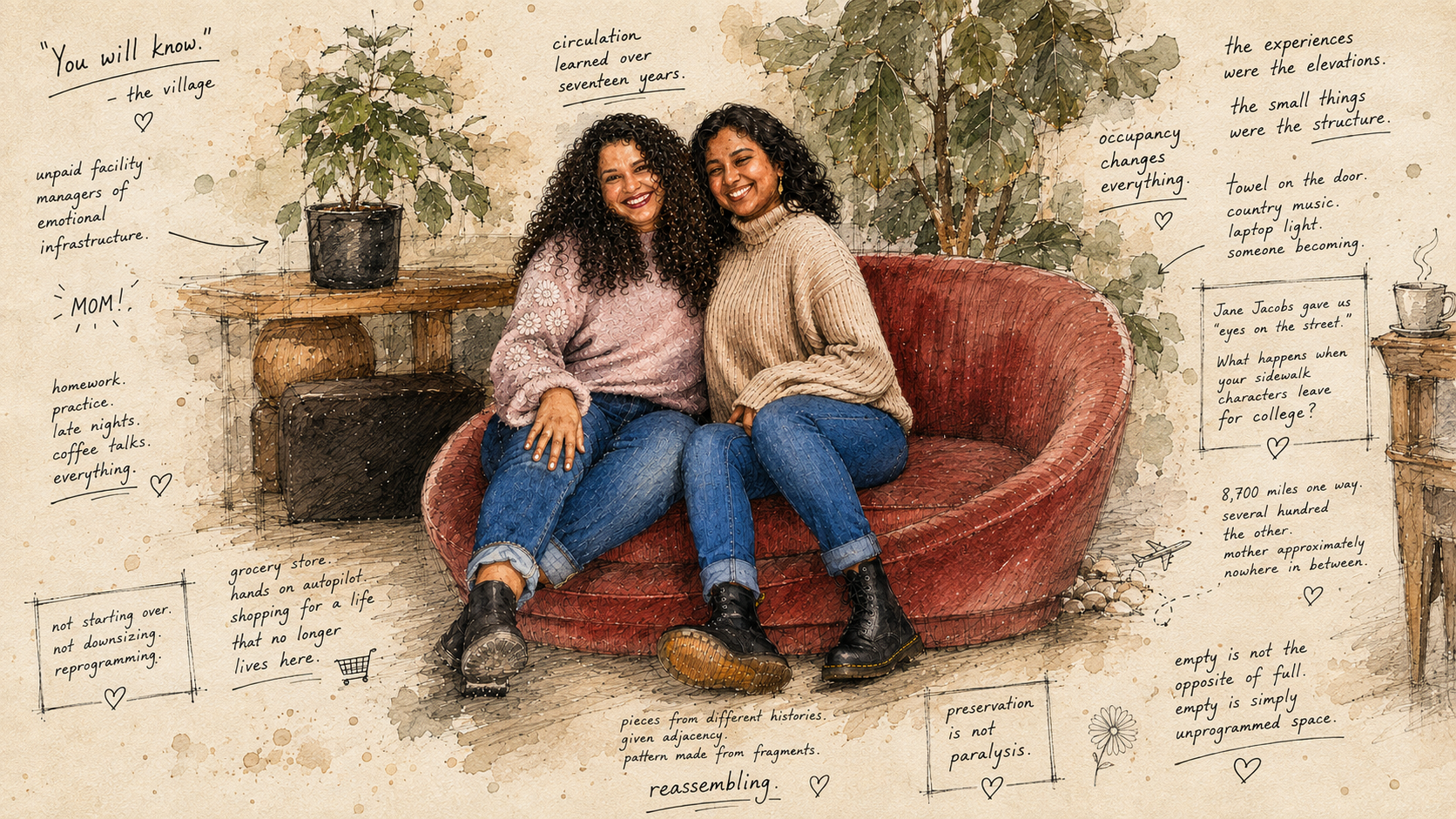
The first night after we returned from dropping off our daughter at college, I walked upstairs without thinking. Motherhood trains the body before it trains the mind. You continue moving according to patterns long after they are no longer required. I reached the landing expecting interruption. A half-open door with a towel blocking other side. Country music escaping beneath it. The blue-white glow of a laptop or phone under a blanket at midnight. The familiar rhythm of someone simultaneously studying, texting, worrying, laughing…and becoming. Instead, the hallway held stillness so complete that the dog sneezed in the living room, and I could hear his fur move.
I lingered a moment more than necessary.
Her room was clean in the unnatural way rooms only become before departure. The bed made carefully for the long-weekend return trip. Closet hangers evenly spaced, nothing half-hanging and clinging for dear life. A candle burned halfway down beside old classroom notes and study cards scattered across the desk with the kind of casual disorder that suddenly becomes sacred once absence enters space. A “one of one” hoodie remained draped over the chair exactly as she left it, carrying the quiet evidence of ordinary life continuing somewhere else now. Nothing inside the room announced grief dramatically. Yet the proportions of the entire house had changed.
People speak about empty nesting emotionally, but almost never spatially.
We speak about pride, transition, distance, independence, identity. But very few people speak about the architecture of it. The physical experience of walking through a house that no longer behaves according to the life it was designed to hold. The way silence reorganizes movement. The way rooms begin revealing themselves differently once they stop absorbing constant occupation. The strange recalibration of living inside a home still shaped for a version of family life that no longer exists in the same form.
As architects, we are trained to observe how people inhabit space over time. We notice worn corners of base molding, chairs that migrate toward windows, pathways that emerge naturally through repeated use. We understand that buildings quietly absorb human behavior long after the people inside stop noticing it themselves. But no professional training fully prepares you for the moment your own home begins reflecting the emotional residue of motherhood back to you through stillness.
For years, our home functioned less like a static object and more like a living operational system. The barely used formal dining room with it’s Frank Lloyd Wright inspired dining table ended up being homework station, emotional recovery room, coffee bar, college application desk, late night confessional, crisis management platform. There were mornings when four conversations unfolded simultaneously across that surface while milk for coffee boiled over quietly in the background and someone searched frantically for missing AirPods five minutes before leaving the house. Family life was never contained by walls alone. It lived through interruption, overlap, compression, negotiation.
The architecture of motherhood is rarely visible in photographs.
It exists in adaptation. Coffee tables become project sites for science fairs, architecture models, financial aid paperwork, and exhausted conversations after long weeks where everyone is trying their best to survive their own becoming. Hallways carry moods, the footsteps falling on the floor could tell how the day was. Bedroom doors carry signals, the banging of the door told stories. Entry area become emotional decompression chambers where entire days are shed onto the floor through backpacks, shoes, jackets, and silence. Cars become moving rooms where some of the most important conversations unexpectedly unfold because eye contact becomes easier when nobody has to face each other directly.
Motherhood reorganizes space constantly.
Not formally. Quietly. You begin designing life around movement patterns you barely recognize yourself performing. Which child sleeps lightly. Which stair creaks. Which room receives the best afternoon light during stressful exam weeks. Which grocery quantities sustain a household operating at full occupancy. Where exhaustion lands physically. Which corners absorb loneliness. Which spaces invite conversation without pressure. Mothers become invisible spatial strategists long before anyone acknowledges the labor itself.
And then one day, the infrastructure exceeds occupancy.
The refrigerator stays full longer. The dishwasher runs less frequently. Entire rooms become emotionally oversized. The Costco-sized household begins feeling absurd for two people. You realize your homes are fundamentally designed around expansion, around childhood occupancy, around accumulation and growth. Very few homes are designed for contraction gracefully. Very few homes understand how to absorb the emotional afterlife of caregiving.
And for immigrant mothers, that afterlife carries another layer entirely.
Part of me still belongs to India. Not geographically anymore, but structurally. I grew up in homes where people arrived without warning and stayed without ceremony. Extra plates existed automatically. Tea appeared before questions did. Someone was always sleeping in another room, calling from another floor, asking if you had eaten yet. Cousins occupied floors during holidays. Steel containers filled with snacks lived permanently inside kitchen cabinets. Pressure cookers announced dinner before anyone needed to ask what was cooking. Sarees dried near balconies while conversations moved between rooms without ending. Love lived through proximity. Through repetition. Through feeding people before feeding yourself.
Silence was rare enough to feel suspicious.
Then I built a life in California. A beautiful one. A demanding one. A life shaped by architecture, leadership, ambition, airports, presentations, deadlines, visibility, expansion, and the relentless forward motion required to sustain immigrant success in America. California taught me another spatial language entirely. Independence. Mobility. Self-authorship. Children raised to leave as soon as they arrive. Their leaving is considered evidence of successful parenting. Bedrooms become temporary launch platforms for future autonomy.
But emotionally, immigrant mothers often remain built for continuity.
In America, good parenting is empty nesting. In India, love was often measured through continued proximity. It still is, with many Indian and other immigrant mothers feeling the ache of children moving out, and trying to find ways to hold on to them. We stretch ourselves across those two systems trying to honor both without fully belonging to either. Part of us still believes family should remain accessible and close. Another part understands the opportunities made possible through independence and distance. We carry inherited collectivism inside highly individualized modern lives. And because the machinery of daily life remains so demanding for so many years, we rarely stop long enough to interrogate the contradiction deeply.
There is another quiet grief inside immigrant motherhood that arrives slowly enough you almost fail to name it while it is happening. One day you realize you are standing in the middle of two departures at once. Your children are building lives ahead of you while your parents remain behind you, aging in another country, another time zone, another version of home you can no longer return to. The immigrant mother becomes suspended between generations physically separated by oceans, carrying responsibility in both directions while belonging completely to neither place anymore.
There are moments when the distance feels almost architectural in scale. You leave a WhatsApp call with your parents in India and walk upstairs into the silence of your children’s empty rooms in California, and suddenly your entire life feels organized around absence. The people who first knew you as someone’s daughter are growing older without your daily presence. The people who made you someone’s mother are growing independent without needing it. And you remain in the middle, holding emotional continuity across geographies that no longer touch physically except through airports, screens, memory, and ritual.
Perhaps this is why immigrant mothers struggle so deeply with stillness.
Stillness leaves room for the full emotional math of migration to surface. You begin realizing that while ambition gave your children opportunities and gave you a life your parents could barely imagine for you, it also quietly reorganized intimacy itself. Somewhere across decades of achievement, mobility, caregiving, and adaptation, home stopped being a fixed place entirely. It became a condition you spent your life trying to recreate for other people. Motion protects us from that interrogation. Especially ambitious women. Especially creative women. Especially immigrant women who have spent decades proving they can hold enormous amounts of complexity without collapsing beneath it.
For most of my adult life, there was very little ambiguity in what I wanted. I wanted growth. Expansion. Stability. Visibility. Meaningful work. Educated children. A beautiful home. Leadership in a profession that did not always know what to do with women like me, immigrant women, mothers whose ambitions disrupted inherited assumptions quietly. And so I built relentlessly. Career alongside caregiving. Architecture alongside emotional labor. Leadership alongside motherhood.
There is pride in that. Real pride.
I do not believe women should minimize the scale of what they survive simply to appear humble in retrospect. Building a full life requires endurance. There were years when every hour belonged to someone or something else. Years when my nervous system became organized entirely around responsiveness. School schedules. Client deadlines. Emotional support. Flights. Deliverables. Family logistics. Presentations. College planning. Quietly maintaining the emotional stability of daily life while still trying to remain recognizable to myself within it.
Motherhood lives inside the body long before it becomes philosophy.
It lives in interrupted sleep. In listening for fever coughs through walls at two in the morning. In carrying sleeping children from the car without waking them. In standing inside dim kitchens making bottles with formula while the rest of the world remains dark and unconscious. In stepping on Legos barefoot before sunrise. In learning how to fold impossibly small clothes while simultaneously grieving how quickly they stop being small at all. NICU babies are another story, another layer that no book or support system can prepare you for.
It also lives in resentment that mothers are rarely allowed to admit out loud.
There were nights when all I wanted was to sit down and finish reading a chapter of a book without interruption. To complete one thought all the way to the end. To end the day when I felt done instead of when the next day’s schedule required me to stop. There were years where I longed for silence so deeply that it felt almost shameful. I wanted five uninterrupted minutes to myself. One evening where nobody needed anything. One morning where my body belonged entirely to me. I spent years wanting solitude without understanding that one day solitude would arrive completely on its own terms.
Now the house gives me entire evenings.
And sometimes I would trade part of that silence for one more ordinary interruption. One more voice calling from upstairs asking where the charger was. One more slammed cabinet. One more bowl left in the sink. One more casual request for coffee while I am trying to finish an email. That is the contradiction motherhood leaves behind. Exhaustion and longing occupying the same room together.
Then suddenly, they leave.
Not abruptly emotionally. Gradually. Then all at once spatially. And the systems that once organized your life begin thinning out around the edges. The shift is subtle at first. No dramatic breakdown. No cinematic grief. Just exposure. The children become more self-sufficient. The operational intensity softens. The house quiets. The calendar opens slightly at the edges. And suddenly there is enough psychological space for deferred questions to finally surface. Questions that motion had protected you from confronting directly.
Who are you when usefulness is no longer your primary identity? What happens after decades spent designing environments for everyone else’s becoming? What remains when interruption disappears?
At first, I responded the way many high-functioning people do. I moved faster. I drove further. There is something deeply human about believing clarity exists geographically. As though the right landscape might reorganize something internally that ordinary life cannot access. So you get in the car. You chase openness because openness feels emotionally corrective. The roads took me through Washington, Portland, California, Nevada, Arizona, Utah, Idaho, Montana and most recently, Wyoming.
And somewhere along those drives, I began noticing scale differently.
In California, the horizon is often interrupted. By density. Infrastructure. Development. Urgency. But in Montana, the sky stops behaving like background and becomes enclosure itself. The landscape recalibrates your proportions psychologically. Roads stretch long enough that thought itself changes rhythm. The body exhales differently there. Spring and winter coexisted simultaneously across the landscape. Snow still lingered beside rivers carrying thawed movement. Frozen ground existed beside emerging grass. Nothing fully resolved. Nothing fully settled. Yet everything belonged exactly as it was. The landscape did not apologize for contradiction. It simply held it without urgency.
One afternoon, we stopped at a grocery store after a drive through Targhee. I walked in automatically, the way mothers do after decades of provisioning life. My body still understood family through food. I moved through the aisles picking up snacks instinctively. Chips and salsa she liked. Granola bars she enjoyed. Fruit she wouldn’t mind in the car. Small things for the drive. Then suddenly I realized none of it was necessary. We were traveling. We were not cooking. Neither of us were really snackers. There was no hungry teenager in the car or at the hotel. No sports practice to pack for. No lunchboxes. No after-school hunger waiting at home.
Somewhere between the cereal aisle and refrigerated section, the heart sank and I started crying quietly in the grocery store.
Not because of the food itself.
Because for years, I had tried so hard to be more than the mother remembered only through meals and routines. I was the ultimate Disney mom with annual passes and Sunday visits. The road trip mom that didn’t shy away from playlists and deep conversations. The architecture camp mom who secretly hoped at least one of them would follow her footsteps. The mother who created experiences and memories and movement and wonder. I wanted my children to remember me through places, conversations, adventures, possibility. I fought hard against the fear of becoming invisible inside domestic repetition.
The quintessential cool mom, standing in the grocery store, realizing food connected all along.
Inside cut fruit. Inside late-night snacks. Inside waiting in parking lots with boba after practice. Inside fennel tea left outside bedroom doors during exam weeks. Inside knowing what brand of cereal meant someone was stressed. Inside the quiet intimacy of feeding people over and over again for years without realizing how much love becomes embedded inside repetition.
In immigrant homes, food is never just food. It is continuity. It is memory preservation. It is apology, celebration, protection, care. I grew up watching women feed everyone first, then stand quietly in the kitchen eating after the table emptied. Somewhere along the way, I inherited the same language of love without fully realizing it. I stood there holding a box of oreos far longer than necessary. And for the first time, I understood that maybe mothers are not remembered through spectacle at all. Maybe they are remembered through repetition.
The same packed lunches. The same cut mangoes. The same rice and curry, idli and chutney, dosa and podi made exactly the right way. The same voice of concern asking if you had eaten yet. The same hand reaching across the table automatically before you even realize you need comfort. That is how mothers remain inside people long after they leave home. Not through grand gestures.
Through rhythm.
The landscape seemed to understand coexistence better than people often do. But eventually another realization arrived too.You do not leave yourself behind simply because the scenery changes. The same questions follow you into beautiful places. The same quiet unrest sits beside you in swanky hotel rooms overlooking mountains and lakes. Geography can widen perspective, but it cannot reconcile the parts of yourself you have postponed meeting.
The road was never an escape. It was a mirror.
Somewhere between Yellowstone and Bozeman, I began understanding that the discomfort of empty nesting is not really about loneliness alone. It is about reintroduction. You are being reintroduced to yourself outside the systems that once defined your days. And that reunion can feel surprisingly unfamiliar. Especially for women whose identities were built through usefulness. For years, my value existed visibly through output. Projects completed. Teams led. Problems solved. Children raised. Deadlines met. Even creativity often existed in service to external outcomes. Architecture is a profession built around solving complexity publicly. Somewhere along the way, I became extraordinarily skilled at creating environments for other people’s becoming.
But empty nesting quietly asks a different question. Who are you becoming now?
That question changed the way I began looking at my own home. At first, I resisted changing anything. Her room remained untouched longer than necessary. The objects felt emotionally active even in stillness. Shoes near the closet. Nearly empty shampoo bottles in the bathroom drawer. Old dance ribbons tucked into corners. Sticky notes still attached to mirrors. Even the light in the room felt unchanged, which somehow made everything harder.
I began realizing that domestic space had quietly become the final site of cultural preservation. Not the office. Not public life. Not achievement. The home. The spice drawer that my mom gave. The rice cooker that I saved to buy. The extra Pendleton blankets folded for guests who may or may not arrive. The freezer still stocked as though children might walk through the door hungry at any moment. The dining table extended for gatherings that no longer happen weekly. The multilingual overlap of conversations that once filled hallways.
The immigrant mother often becomes the final physical bridge between worlds without ever fully recognizing the scale of what she is carrying. And then eventually, the bridge stands quieter too. Eventually, the house itself begins asking for evolution. Not erasure. Evolution.
I began realizing women experience adaptive reuse emotionally all the time. Especially mothers. Especially immigrant women who have already reconstructed themselves repeatedly across continents, professions, languages, expectations, and identities. Eventually every life reaches a moment where its original shape no longer fully fits. The structure still stands. The bones remain sound. But the emotional purpose changes. The question is no longer how to preserve what existed exactly as it was. The question becomes how to evolve without betraying memory. And perhaps this is why I keep thinking about quilting.
Not architecture. Quilting.
I was ten years old when I first became fascinated by quilts. Not because of craftsmanship alone, but because of what they represented emotionally. Fragments assembled into continuity. Softness made structural. Memory preserved materially. Nothing wasted. Small pieces becoming whole through patience instead of force. Somewhere along the way, I categorized that desire as too small to matter.
Architecture became the serious pursuit. Leadership became the meaningful pursuit. Building measurable impact became the valuable pursuit. Quilting belonged to another category entirely, one associated with slowness, tactility, domesticity, care. Things ambitious women are often taught to deprioritize once scale and performance begin defining worth publicly. I spent years trying to transcend domesticity because I was afraid of disappearing inside it.
And now I wonder if I misunderstood it entirely. Because domestic life was never intellectually small. It was infrastructure. Emotional infrastructure. Cultural infrastructure. Memory infrastructure. The entire architecture of belonging often rested inside labor nobody considered ambitious enough to celebrate publicly. And now I wonder whether that younger version of myself understood something long before I did.
That not everything meaningful needs scale. Not everything valuable needs visibility. Not everything sustaining needs to perform publicly. Architecture taught me scale. Quilting asked for patience. Architecture trained me to think about systems, permanence, coordination, complexity. Quilting asks for slowness. One seam at a time. One fragment slowly finding relationship to another. One imperfect piece helping hold warmth for someone else eventually. There is something deeply healing about that shift.
Especially after decades spent living at the scale of relentless output.
I think many women eventually reach this threshold without fully knowing how to articulate it. We spend years designing environments for everyone else’s growth while quietly postponing parts of ourselves that felt too small, too impractical, too soft to prioritize. Then one day the house quiets enough for those deferred selves to become audible again. And suddenly, the life ahead no longer asks for expansion alone.
It asks for inhabitation.
Because achievement and inhabitation are not the same thing. You can build an extraordinary life and still remain emotionally absent from parts of it. You can become highly functional while remaining disconnected from quieter forms of aliveness. You can master endurance while forgetting how to rest fully inside your own existence. I do not know if I was always fully present. I know I loved deeply. I know I tried relentlessly. I know there were moments I was physically there while mentally solving ten other problems at once.
Maybe that is motherhood too.
Maybe the empty nest did not create those realizations. Maybe it simply removed enough noise for me to hear them. Lately, I find myself looking at my home differently. Not as preservation alone. Not as memorial. But as invitation. Perhaps one room becomes a studio for fabric and unfinished ideas. Perhaps the house evolves alongside me instead of remaining permanently anchored to who I once needed to be. Perhaps beauty can exist now without justification. I am beginning to think softness needs space too.
That feels radical after a lifetime of utility.
But maybe this season of life is not asking me to become smaller. Maybe it is asking me to become more precise. More honest. More inhabited. The girl who once wanted it all was not wrong. She needed ambition. She needed expansion. She needed to test the edges of what was possible for an immigrant woman carrying motherhood, architecture, leadership, and survival simultaneously. She needed to build a life large enough to hold everyone she loved.
And she did.
But the woman standing in this quieter house now understands something different. Life cannot only be held together through endurance. Eventually, it must also be lived gently. And perhaps that is what motherhood was trying to teach me all along. Not through the extraordinary moments. Through the ordinary ones. Through cut fruit. Through packed lunches. Through waiting lights left on late at night. Through grocery aisles. Through interruptions I once longed to escape and now ache to hear again.
Perhaps that is what “little bitty” meant all along.
Not that life should become smaller, but that even the smallest parts are large enough to shape an entire life.
Leave a comment